6DoF Visual-Inertial SLAM Module for Robotics
A multi-revision PCB exploration for an embedded visual-inertial SLAM module — sub-watt, board-scale, market-validated through real-use deployments.
The challenge
A computer-vision team is building a new product category — embedded visual-inertial SLAM in a form factor small enough for drones, robots, and battery-powered platforms. The design space is wide: camera count, processing topology, and physical configuration each open up architectural choices that can’t be settled on paper. The team needed a hardware partner who could iterate with them — turning each architectural hypothesis into a real PCB they could integrate into a host system, run against actual workloads, and put in front of the market.
What we built
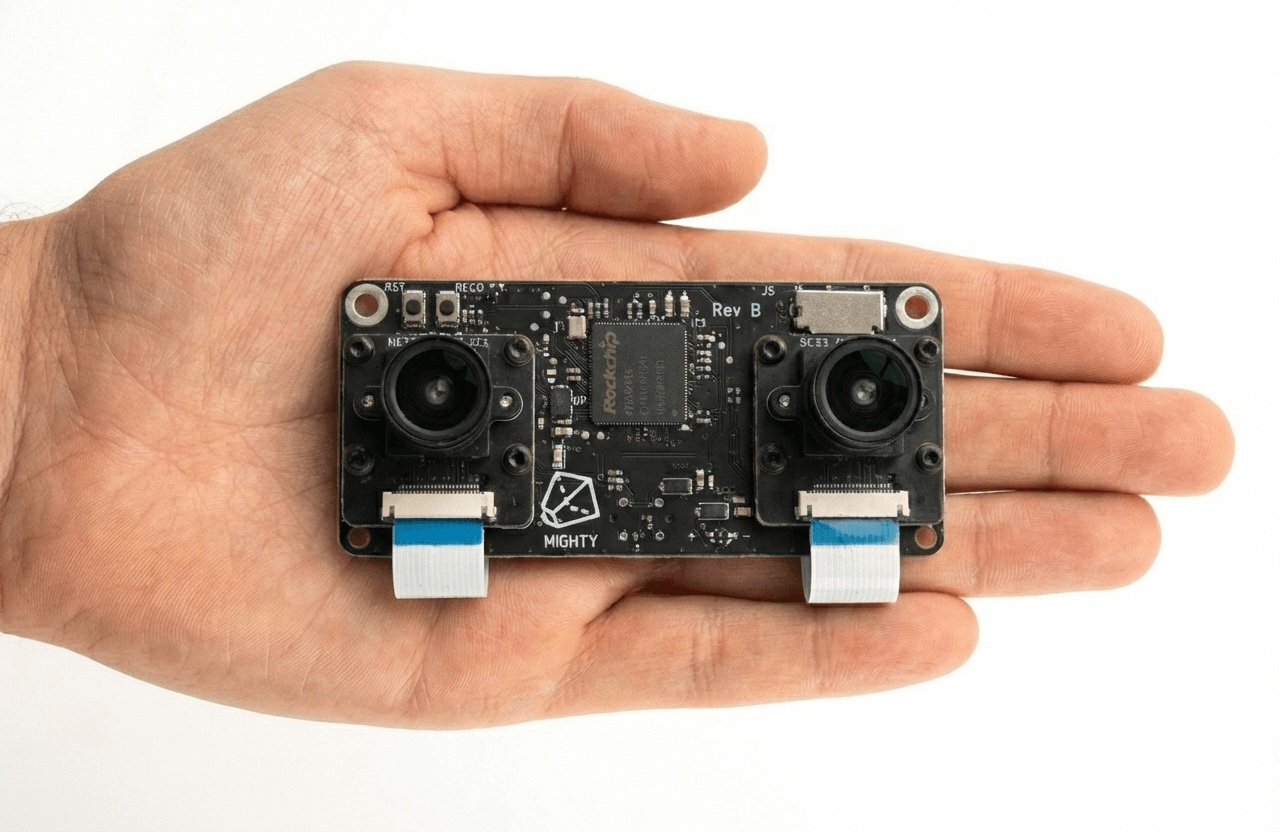
Across the engagement, Atallis has designed several PCB variants exploring different directions:
- Camera count — single OV9281 global-shutter module versus stereo pairs, with the layout adjusted for the bandwidth and synchronization constraints of each.
- Processing topology — Rockchip RV1103G1 ARMv7 SoC alone versus a paired arrangement with a dedicated low-power MCU handling IMU sampling and timing-critical work.
- Physical configuration — board outline, connector orientation, mounting points, and antenna placement tuned to fit different host platforms.
Every revision keeps the same baseline building blocks — global-shutter imager(s), the ICM-42670-P 6-axis IMU, a sub-watt power tree, and USB / UART / MAVLink-friendly outputs — and reshapes the architecture around them.
Validation in the field
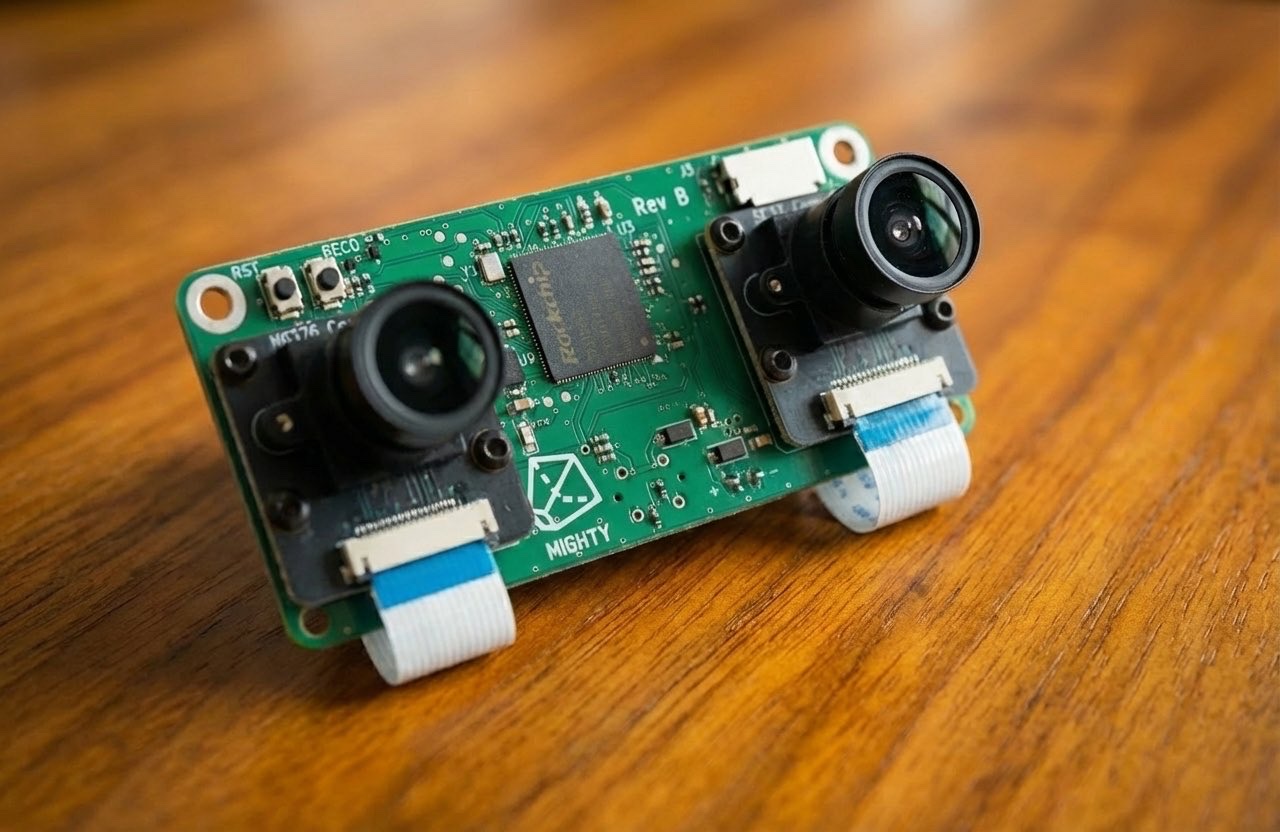
Each prototype is built to be tested, not just demoed. The customer puts every revision into real-use-case integrations — drone platforms, robotics rigs, navigation setups — and uses public-facing pre-order and developer-outreach campaigns to gauge concrete demand for each configuration. The signal coming back from those deployments and campaigns feeds directly into the next revision’s spec, so each board is shaped by what users and the market are actually responding to, not just what’s technically possible on paper.
Outcome
A multi-revision PCB roadmap that has narrowed the product direction through concrete data: which configurations integrate cleanly, which generate real demand, which are too expensive to manufacture. Firmware, algorithms, and SDK are owned by the customer’s internal team; Atallis remains engaged on the hardware side as the architecture evolves toward a production-intent design.