A client called me last month, certain they needed a LiPo. Their product was an industrial sensor for cold storage warehouses. “Rechargeable is more modern,” they said. I asked them one question: who is going to plug it in?
Silence.
That’s where most battery decisions go wrong. People pick the cell first, then try to design the product around it. The order should be reversed.
Battery selection is a user-experience decision
Capacity, chemistry, voltage, form factor. These all matter, but they only make sense once you know who deals with the battery and how often. The product’s electrical design follows. Not the other way around.
I think about three end-user profiles when I start a hardware project.
Consumer. Wants zero friction. Will tolerate charging because they already charge ten other things every night. Will hate replacing batteries. Will lose the charger.
Technician. Trained, paid to maintain equipment. Has a procedure, a toolkit, and a maintenance schedule. Replacing a battery on a defined cadence is a non-event.
Employee on the floor. In between. Will tolerate charging if it’s painless (drop-in dock, no cables). Will tolerate swapping if it takes less than thirty seconds and the spare is right there in a drawer.
Match the battery strategy to that profile first. Everything downstream becomes easier.
Replaceable vs rechargeable
Once you know who is dealing with the battery and how often, the next decision almost makes itself.
Replaceable cells (alkaline, lithium primary, NiMH) shine when the product sits where charging is impossible or annoying (remote sensors, field equipment, anything mounted high or behind a panel), when the user is a technician or an existing maintenance crew, when the expected battery life lines up with an existing service interval, and when a few seconds of downtime to swap is acceptable.
Rechargeable chemistries (Li-ion, LiPo, NiMH packs) shine when the product returns to a known location often enough to be charged, when the energy budget is too high for primary cells to keep up, when the user is the same person every time, and when the form factor demands density that AA or AAA can’t deliver.
Mix them only when you have a reason. A hybrid setup (USB-charged with a backup CR2032 for state retention) adds cost and BOM complexity. Sometimes worth it, often not.
A word on safety, because LiPo is not free
LiPo is the default reflex for a lot of hardware teams. It shouldn’t be. Lithium polymer cells need a proper BMS, they hate heat, they swell when abused, they carry shipping restrictions (UN 38.3, IATA rules), and they age whether you use them or not. If your team has never integrated a battery-protected charging circuit, designed a cell-balancing strategy, or specified a safe charging profile, you are taking on real engineering risk before the first prototype is even built.
NiMH is friendlier. Lower energy density, but no thermal runaway concerns, no swelling, and no certification headache for shipping. Low self-discharge versions (the Eneloop family being the obvious reference) keep usable capacity for months on the shelf.
Alkaline and lithium primary cells are even safer in a finished product: no charging circuit, no BMS, no “what happens if the user does X”. The trade-off is energy density and cost over the product’s lifetime, especially if the product runs continuously.
The rule I follow: if the product will live in high-temperature environments, be used by untrained operators, or sit in any safety-critical context, LiPo is the last option I consider, not the first.
Energy density vs form factor
This is the trade-off most engineers think about first, even though it belongs last.
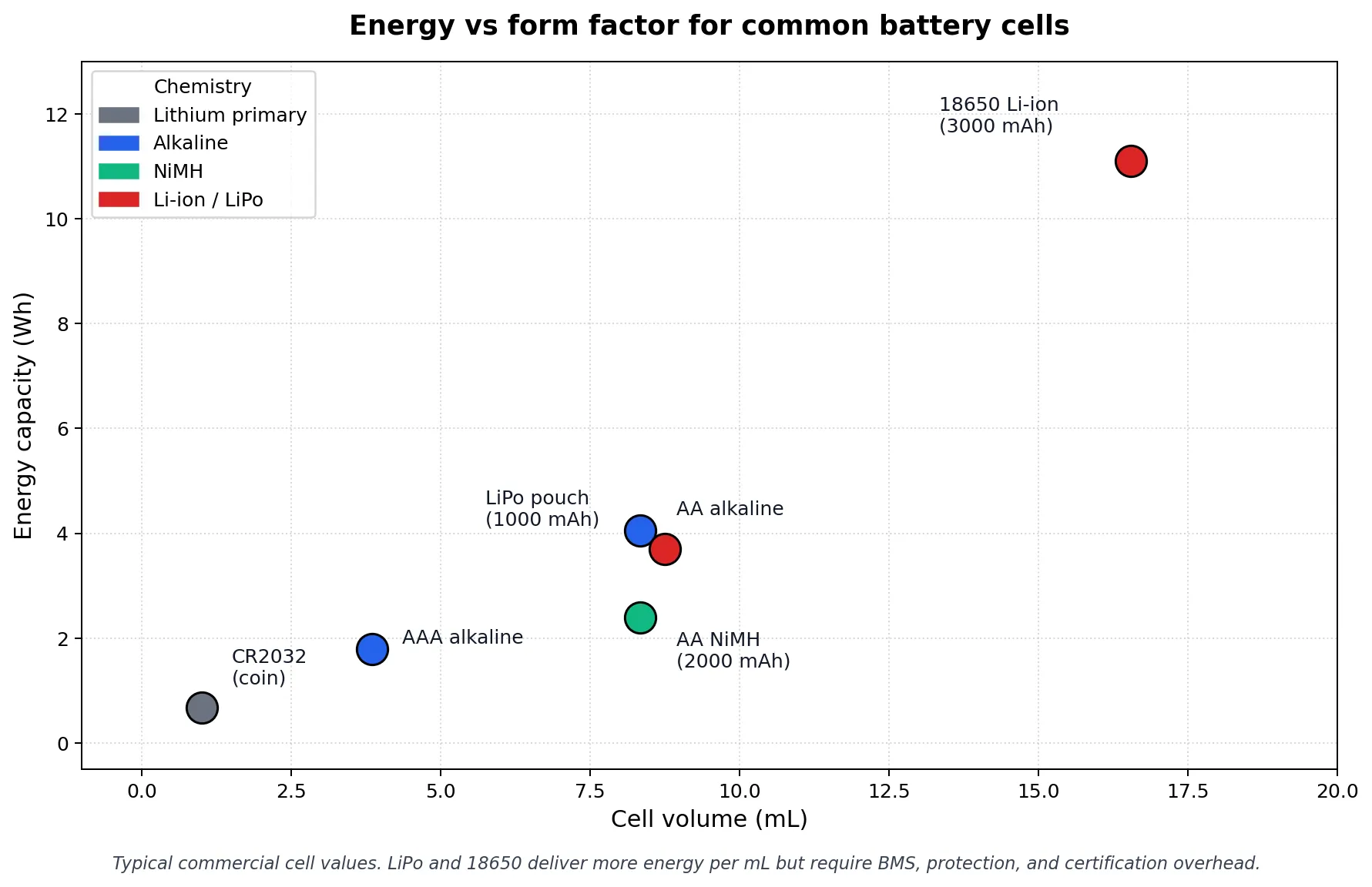
A coin cell holds very little energy but fits inside a pen. A LiPo pouch can be shaped to a custom enclosure but pulls in protection circuitry, charge management, and a USB connector. A pair of AAA cells delivers usable runtime in a form factor every human on the planet recognizes, with zero design complexity. An 18650 is dense and cheap per Wh, but it’s bulky and consumer-unfriendly outside of flashlight territory.
The right answer is rarely the densest cell. It’s the cell that fits the product, the user, and the maintenance reality at the same time.
A real example: industrial remote control, eighteen months on three AAA
Last year I designed a wireless remote control for a piece of industrial equipment. Used a few times per day by an operator on the floor. The client’s first instinct was a LiPo pack with a charging dock at the workstation.
I pushed back. Their plant runs a full annual maintenance shutdown. Every piece of equipment is inspected, lubricated, and serviced once per year. So I asked the question that decided the whole battery architecture: what if the cells just get swapped during the annual service?
I designed the firmware around aggressive sleep. The MCU drops below 100 µA in idle. The radio wakes only on button press, transmits, and goes back to sleep. The result: three AAA cells deliver roughly eighteen months of runtime. The maintenance team already opens every device on their annual round. They drop in three fresh alkalines. Done.
No charging dock. No proprietary cable. No “the remote is dead again” support ticket. The battery problem disappeared because the battery cadence matched a cadence that already existed on site.
What I tell clients
If you’re starting a hardware project and someone on the team is already deep in a LiPo datasheet, stop. Go back to the user. Ask who is responsible for the battery, what their tolerance for friction looks like, and what schedule already exists in their workflow. The cell almost picks itself once those answers are clear.
Most products don’t need a custom battery solution. They need a battery strategy that respects the people who will live with it.