This is one of the most common questions in hardware projects — and also one of the hardest to answer with a single number.
Not because engineers like being vague, but because hardware timelines depend less on effort and more on sequencing.
In practice, the real question is not “How fast can we build something?” but “How fast can we reduce uncertainty without breaking things later?”
The short answer (and why it’s misleading)
A functional hardware prototype can take anywhere from a few weeks to several months.
That answer is technically correct — and practically useless.
Two teams can spend the same amount of time and end up with completely different results, simply because they asked different questions early.
Hardware timelines don’t stretch because teams move slowly.
They stretch because reality tends to show up late in the process.
What “functional” actually means
A functional prototype does not mean a finished product.
It means a system that answers the right questions at the right stage.
Depending on your goal, “functional” might mean:
- The electronics power on reliably
- Sensors behave consistently in real conditions
- Connectivity works outside the lab
- Stakeholders can interact with the device and understand its value
Trying to make everything perfect at once usually slows projects down rather than accelerating them.
A realistic timeline (in broad phases)
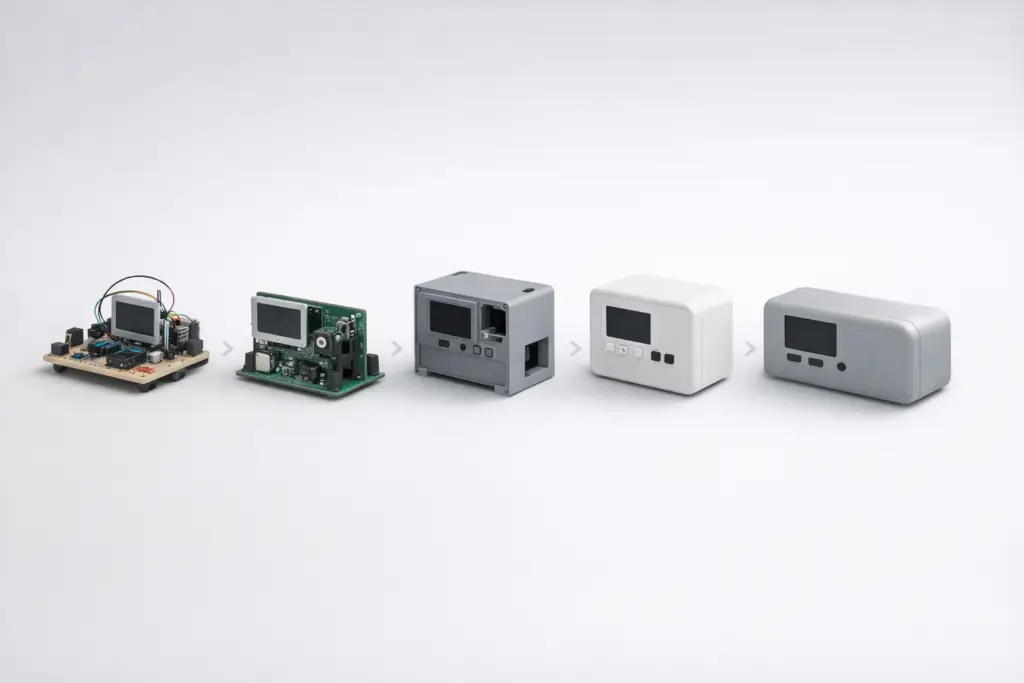
Most successful hardware prototypes follow a sequence, not a sprint.
- Exploration and feasibility (2–4 weeks): clarifying constraints, architecture choices, and unknowns.
- First functional prototype (3–6 weeks): something testable, demonstrable, and imperfect.
- Iteration and refinement (ongoing): improving what matters, discarding what doesn’t.
The first prototype is rarely the one you keep.
It is the one that teaches you what to build next.
Why timelines slip (even with good teams)
Most delays don’t come from execution.
They come from early assumptions that quietly turn into constraints.
- A component that looked fine on paper but behaves poorly in real conditions
- An enclosure that limits thermal or RF performance
- A power strategy that works in isolation but not as a system
None of these are mistakes.
They are part of how hardware reveals itself.
Speed comes from decision quality, not pressure
Adding pressure rarely makes hardware faster.
It usually just makes trade-offs invisible.
Teams that move fastest are not the ones that rush.
They are the ones that make early decisions intentionally — and revisit them when reality provides new information.
A practical way to think about timing
If your timeline depends on everything going right the first time, it’s probably optimistic.
If it includes space to learn, adjust, and validate, it’s probably realistic.
In hardware, progress is measured less by how quickly something is built and more by how quickly uncertainty is reduced.
Final thought
A functional prototype is not a finish line.
It is a checkpoint.
The goal is not speed for its own sake, but momentum built on solid decisions.
That is what keeps projects moving forward — even when reality has other plans.
Atallis works with teams who need clarity, speed, and reliable early hardware decisions — without building an internal hardware team too early.