Hardware projects rarely fail because of a lack of effort.
They fail because early decisions are made without enough information, structure, or perspective.
At Atallis, our role is to help teams navigate that early complexity with clarity.
Not by adding process for its own sake, but by structuring decisions so progress remains predictable and useful.
Our role: a prototype partner, not a contractor
We do not operate as a task-based execution team.
Our role is closer to a technical partner who helps you think, decide, and validate — while also building what is necessary to move forward.
This distinction matters.
A prototype is not just something that works.
It is something that answers the right questions at the right time.
Starting with clarity, not assumptions
Most hardware projects begin with a mix of ideas, constraints, and unknowns.
Before building anything, we focus on clarifying what actually needs to be validated.
This typically includes:
- Understanding the product intent and context of use
- Identifying technical unknowns and assumptions
- Defining what success looks like for the next stage
This step is less about documentation and more about alignment.
It prevents teams from investing time and money into answers they do not yet need.
Building only what reduces uncertainty
We approach prototyping as a tool for learning, not as a race toward completeness.
Instead of trying to build everything at once, we focus on:
- Validating feasibility early
- Testing integration points where risk is highest
- Creating prototypes that are functional, testable, and explainable
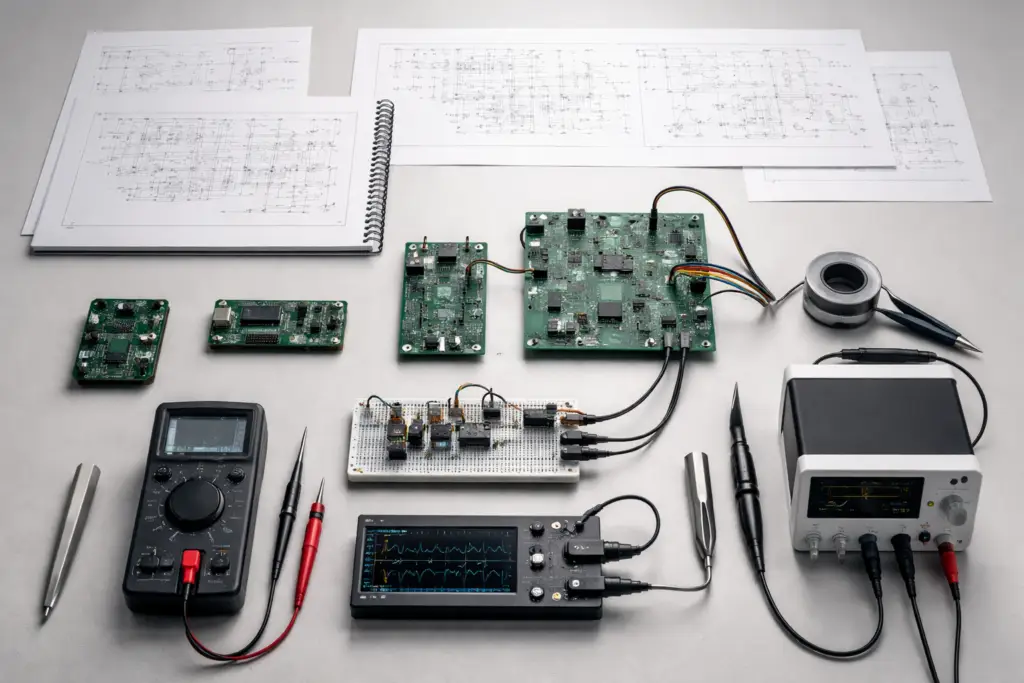
This often means using pragmatic approaches — development platforms, modular electronics, and simple mechanical integration — when they serve the goal better than custom designs.
Iteration with intent
Iteration is unavoidable in hardware.
What matters is whether it is intentional or reactive.
Each iteration should:
- Answer a specific question
- Reduce a known risk
- Inform a concrete next decision
When iteration is structured this way, progress remains visible and measurable, even when the design evolves.
Transparent trade-offs and decisions
Hardware development is a sequence of trade-offs.
Cost, complexity, reliability, time, and flexibility are always in tension.
Our role is not to hide those trade-offs, but to make them explicit.
That way, decisions remain yours — informed by engineering judgment rather than guesswork.
Working across disciplines
Early hardware rarely fits neatly into one domain.
Electronics, firmware, and mechanical constraints influence each other continuously.
We work across these boundaries to ensure that:
- Electronics choices make sense mechanically
- Firmware assumptions hold in real conditions
- Integration issues surface early rather than late
This integrated view helps avoid surprises that typically appear when disciplines are handled in isolation.
Documentation that supports decisions
Documentation is not an end in itself.
Its purpose is to support continuity and future decisions.
We focus on capturing:
- Key architectural choices
- Important constraints and assumptions
- Clear recommendations for next steps
This allows teams to move forward confidently — whether continuing with us or transitioning internally or to another partner.
Local presence, flexible collaboration
Atallis operates as a hardware prototyping studio based in Montréal, working with teams across Canada and the United States.
Projects are typically a mix of remote collaboration and targeted on-site work when physical interaction with hardware adds value.
What matters most is not proximity, but clarity of communication and shared understanding of goals.
Final thought
A good hardware process does not eliminate uncertainty.
It makes uncertainty visible, manageable, and useful.
That is how prototypes become progress rather than detours.
Atallis works with teams who value clarity, disciplined decision-making, and reliable early hardware validation.